Computer Gaming has been in my life from as far back as I can remember. I started playing them at my cousin’s place each time we visited, and especially in this part of the world, very few people had computers. The Internet was non-existant at the time. The entertainment value of games was not in the graphics, but largely in the story and gameplay interaction. I remember sitting behind my cousin as he played through Kings Quest, unveiling the story and solving puzzles along the way. I felt that was really cool!
LucasartsI think that was the start of my own journey with point and click adventure games. I fondly remember Lucasarts classics like the Monkey Island series, Full Throttle, Indiana Jones and the Fate of Atlantis, Sam and Max Hit the Road, and Day of the Tentacle, Sierra classics like the King’s Quest series, Torin’s Passage, and even Phantasmagoria, at the time requiring a whopping 7 CDs. The dialogue was witty, and the gameplay had a puzzle solving approach which brought hours of entertainment. I remember playing Robin Hood, trying to win the tournament splitting an arrow, and having Indiana Jones find Atlantis – these are some of the moments that defined my early computer game experience.
Over the past 10 years or so however, the genre has seemingly faded into the background, with some occasional gems like The Longest Journey and Syberia giving us a taste of how fun and witty story telling can be captivating and thoroughly enjoyable. However, it hasn’t been a genre that has gotten a lot of attention. Strategy games, RPGs, FPS, and even simulation games seemed to be doing a much better job drawing players and retaining them. Lucasarts all but stopped investing in the genre, and Tim Schaffer, one of the designers of much of the classics at Lucasarts left forming Double Fine Productions back in the year 2000. Other game designers also left Lucasarts and formed Telltale Games, taking over releasing further episodic titles of titles such as Sam and Max and Monkey Island as well as some other game adaptations.
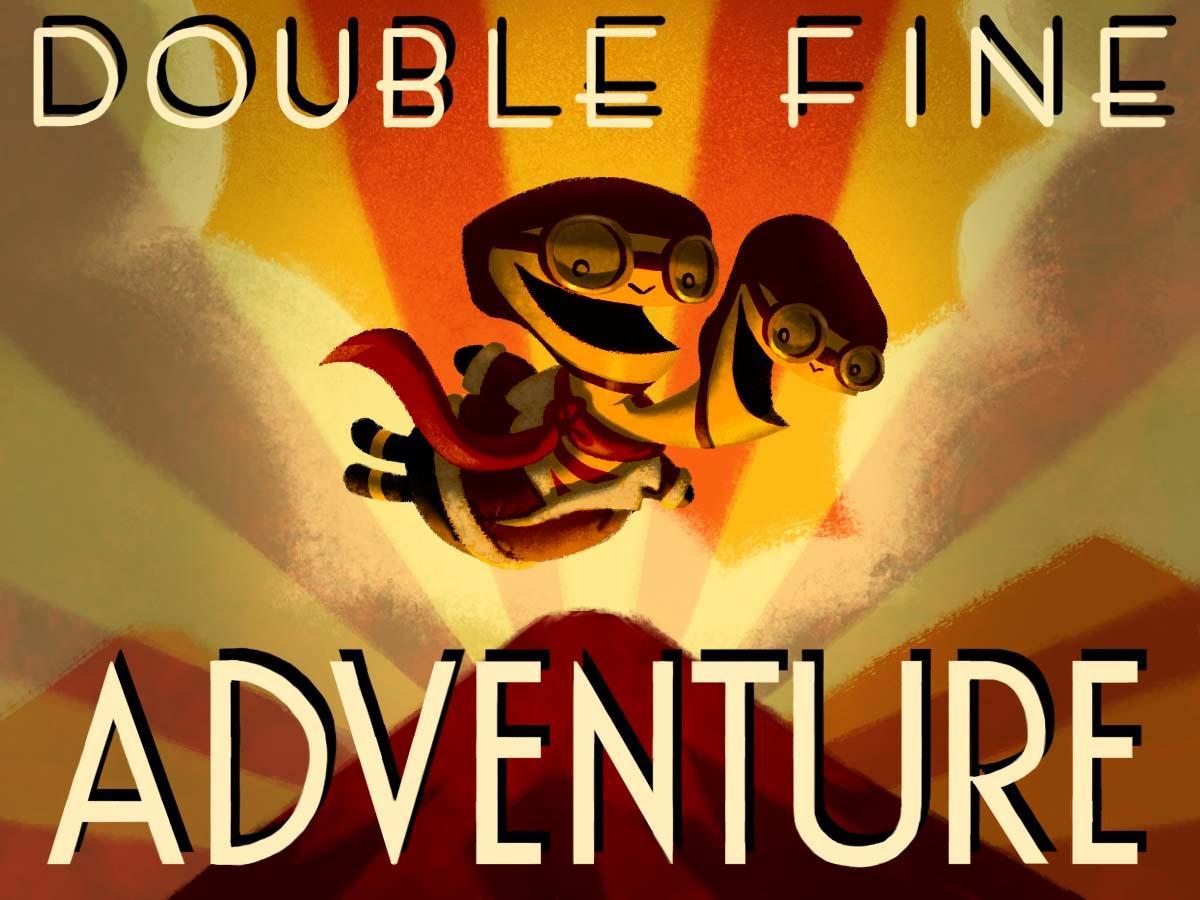
Double Fine AdventureIt was a struggle initially, as these new developers and publishers fought to release their games in a time when the market seemed to have eyes only for RPGs and FPSs. Story telling in games appeared to have fallen by the wayside. However, thanks to initiatives such as Kickstarter, things may be looking up. Also, in this age where every IP gets milked for all its worth, new and exciting ideas and IP are uncommon and present a risk that these game developers and publishers face. However, there is a huge demand in the market for fun original ideas, and what better way to establish this than with games that tell a story with wit, humor and character development.
Recently, I’ve had the privilege of playing Deponia and The Book of Unwritten Tales, both fun and interesting releases that make me hope that the genre is again on the rise. Kickstarter has given Double Fine a breath of life, and I hope my contribution to it will further contribute to the revival of this genre. I’m excited for it!
I read this article and I was just thinking that it made a lot of sense. I thought how cool it would be to be a great story teller, to be able to captivate and enthrall listeners. I think being heard and understood is an awesome thing, but it only comes with good communication skills, and a knack for drama in the literary sense…
Story Teller
Over the years, I realized I’m an awful story teller!
It takes a lot of skill to capture the attention of people. Some are born with it, a natural charisma that is magnetic and attracts people. Others work for months and years, and even then not all gain the level of a virtuoso who can command attention by the sound of their voice.
There are many facets of story telling, with words being just one of them. It can be the tone, cadence, gestures, facial expressions, but it all comes together into something that either bores you, or sparks your interest and holds your attention.
The gist of it, the content, can sometimes be unimportant. Truly masterful communicators and story tellers can make their audience stand at rapt attention even if the subject matter is dry and uninteresting.
It’s all about how you connect people to what you are saying. The more connections you can establish in the audience’s mind, the more you they are willing to listen to you.
Theatrical SettingStory tellers are theatrical people. They perform on to an audience sometimes of only one person. Their communication embodies artistic aspects to express and send out messages that are consumable by the listener. Listeners enjoy it, being able to identify the ideas sent out by the story teller. They relish being open to new and sometimes even old ideas!
Often we have a huge idea or understanding in our heads. We know the concept instinctively, but it is the communicator that manages to share forth that idea in a clear and concise way! I’ve sat in presentations and even napkin drawing discussions where I came out realizing that it wasn’t something new that was shared, but the WAY it was shared was simple and revolutionary, and essentially brought to remembrance the concept that was being communicated much more clearly and effectively in my mind!
The good news, is that this can actually be learned. Articles like the one above give us a clear idea on how we can improve ourselves, but like all skills it takes practice, diligence and lots of trial and error. I’m hoping I can improve, even if just a little bit, my story telling and communicating skills each day. It’s going to be awesome for work, but it’s also important to me as a person. I’ve been striving for a lot of growth the past year, and this area is no exception!
So it’s been more than a year in my current role, and I’d like to share my views on my current jet-setting lifestyle. Looking back, since I took on this role back in August last year, I’ve traveled to more places within this one year alone, than all my other travels put together in my life! That’s pretty amazing, and I’ve learned a little about how to cope with hectic travel lifestyles.
Firstly, I’ve learned that a good piece of luggage will work wonders for you. I started my travels to nearby places within the region, and the weather isn’t usually much of an issue. I even had my first overseas holiday since I graduated within this window, and experienced my first autumn in Japan. That was an interesting experience although I didn’t have much in terms of luggage then. I got a pretty good piece on sale a couple of months back, and it hasn’t been the same since.
One of the biggest things to note is that checking in luggage is a must when travelling for work. I used to try and squeeze a lot into a small hand-carry sized bag, but that’s absolutely horrible when you have to bring a suit. You should fold it only once, meaning you need a luggage big enough for that. Moreover, it’s pretty convenient to hit the gym while travelling as most hotels have a pretty well equipped fitness centre. With a bigger bag, it’s become the norm for me to bring my gym clothes and shoes so I can work out even while travelling – if I can squeeze in the time that is.
Credit CardsSecondly, credit cards are very important, and since it is on company expense, it makes a lot more sense to use it than paying cash for everything. My claim amounts are done based off statements in my bill, allowing me to ensure I am reimbursed at the same rate I paid out, effectively reducing it to a single currency. This applies much more to more advanced nations which has more services (taxis etc) that accept credit cards. Of course, most big ticket items like your hotel will accept cards, and using it there should be a given. Understandably, places like Bangkok, Manila, Indonesia and KL require carrying more cash around, but the amounts are usually small enough that its fine to just exchange upon arrival at the airport.
I use a single credit card for my overseas trip expenditures, ensuring I have a good view of my expenses. I even use the bill as part of my expenses receipts to show the exchange rate value. There is, however, one issue that I’m still trying to find the best solution to. My expenses vary depending on the place I am going to. A trip to Australia costs significantly more than a trip to Bangkok, and the difference in my claim amounts can at times cause some cash flow issues for me, as I try to set aside a certain amount each month for savings, which makes it hard to track if your savings account is fluid. One potential workaround is to have a buffer in my spending account in the amounts of my highest travel so far (thanks to my sis for the suggestion), and I’m thinking of trying it out to see if that works.
Travel insurance is another thing that’s important. I had the unfortunate experience of having my luggage misplaced on connecting flights, and this has happened more than once! I’ve learned to make it a point to get travel insurance whenever taking more than one flight as there is actually quite high a risk that you will land without your luggage. On my last trip to Montreal, when I had two transfers to make, my luggage was actually stuck in Hong Kong, and it took more than 72 hours to get it delivered to me. Thankfully, the airline was kind enough to authorize me a reimbursement of USD300 for my troubles, but it was a very VERY tedious process. I could have easily made that claim and avoided all that hassle had I got travel insurance (something my HR / Admin staff neglected to purchase together with my flight). Of course it may not happen to you, but it is a crappy feeling to arrive at your destination, half way around the globe, only to find you do not have your luggage with you. I was there for two weeks, and thank GOD it wasn’t winter!
Related to this, is the advice to also ensure you have a hand carry luggage with you that has at least one to two sets of changing clothes with you that isn’t checked in. I was saved because I actually DID have an extra hand carry with two sets of clothes, allowing me to last for 2 days (three because I did my laundry) before my luggage arrived. Of course, once I knew they were going to compensate me for losing my luggage, I went shopping knowing I had just “earned” USD300.
I think I’ll stop here. There are some other things to consider including having medication and managing jet-lag, but I’ll save it for another time. Trips, even if it’s for work, don’t have to be a harrowing experience, and can even be fun and exciting, but only if you learn how to manage it well. Now, if only I can travel more often for leisure… 🙂
Growth
So the last time I posted, I was frustrated because it was a time of trials, and it’s not like I’m out of the woods just yet. However, I’ve gained quite a bit of confidence lately, mostly due to the fact that I’ve been told that I’ve matured!
So I can only say that the trials I’ve gone through have made me grow up to a higher level. I believe it was all for a good reason and while I may not have “arrived”, I know at least that I have progressed! That is reason enough to celebrate!
Growth is always a sticky point. I don’t ever want to stop, but it also means I can’t stop feeling uncomfortable and keep pushing my own limits. Still it feels good to be going up a level, and one of the greatest feelings to me is looking back and seeing how far I’ve come. It’s a real ego booster!
So don’t stop growing, striving, changing… Did I mention it should be easy? Not easy because there aren’t many bumps along the way, but easy because He will make sure it happens, so just enjoy the show!
It’s funny how after I posted about learning responsibility, I’m faced with the accusation that I’m not taking enough responsibility. It’s really not a nice feeling.
ResponsibilityI don’t know what it is with me and D people. Why do all the people around me have the same personality? D people are supposed to be super rare, but they somehow appear in significant numbers in my life.
And if there’s one thing I learnt about D people, is that regardless of what you think, your best response is to just shut up, nod your head and agree even if you disagree. Why argue with a D? They will never consider themselves wrong, and regardless of what I think, cannot agree to disagree, or concede that someone else may have a point. They are so convinced they are right that it is an exercise in futility to engage them. Any point raised just gets refuted, and even if I don’t agree with the rebuttal they will get louder, more verbose, more passionate until I rather just shut up. I’m not conflict driven. They cannot accept that everyone is different, have different views, may have different ideas, beliefs, thoughts… They must all bow down and concede that THEIR ideas, beliefs and thoughts are the only correct one.
So just go along. I mean, why ask for my opinion when even after it is given you will just do what you want – you already know what is “best” after all. Why should I bother since it seems to be more practical that I just follow what you say? So please don’t complain when eventually you feel nobody else is helping you make decisions. The decisions I made you questioned and disagreed with. You neither teach nor guide in decision making, saying I don’t think when I do things, and apparently there is such a thing as dumb questions. So I stop asking. I stop learning. And you blame me for not helping?
This is likely the biggest flaw in my personality – I grew up always agreeing, and therefore it seems I don’t know how to drive or to think.
This is not just about attitude. How do you break out of your shell and step out of your comfort zone when your gut instinctive reaction is always to fall back on the familiar and comfortable? It’s difficult, and it’s tiring, and it’s only when you are forced to that you would grit your teeth and go for it.
I guess sometimes we really need to be plunged into the deep end in order to struggle and be challenged. I thank God in the many difficulties and challenges I face – all opportunities to help me grow and mature.
Responsibility is just a word, but it’s a big, heavy one when it comes to being an adult. Often, we think that we already “know” what it means to take responsibility. Maybe a lot of you do, but I found out first hand that I wasn’t as responsible as I thought I was, and these few months have been a journey to learn that there’s still some ways to go.
They say that maturity comes from the willingness to accept responsibility, and that is precisely what a lot of people are afraid to do. That sounds very cliché, but while many of us know this in our heads, knowing it in our actions and decisions is a whole other matter.
Taking ResponsibilityI’ve tried often to define what it is that can make me mature even further. Is it being bold to take action? Is it understanding and learning more? Is it the tenacity to push on? Is it experience and contemplation? I honestly don’t know… What I do know is that someone who is mature would decide to be bold when needed, to understand and keep an open mind, to keep holding on in difficult times, and to take life lessons as it comes, always growing from each decision and situation, especially over something that he/she is responsible for.
What does it mean to be responsible over something? I used to be very naive about it; Just because I was a “leader” executing does not make me a responsible person. True responsibility is when only a concept or general idea is provided, and we take it, run with it, and do WHATEVER it takes to make it succeed, and that’s the one thing I learnt pretty much the hard way.
See, it wasn’t the execution that made you responsible or mature. If you only worked within the framework that is clearly defined in every way for you, you are just another cog in the system of things. You may be the most efficient cog, but you are running based on somebody else’s design. The responsibility comes when you are given a blank space, and you need to fill up every single part to design and make something that works! That’s real responsibility!
It takes a lot of courage. You have to step out of the safety net and comfort zone. You have to force yourself to think in view of the full picture, because YOU are the safety net, and it is by default a failure unless you make it succeed! It can be a project, a task, a relationship, money, an object, or even an idea, and it all hangs on YOU!
So I’ve gotten my share of being corrected, but I must say it is absolutely important that we understand what it really means to take ownership of something! It is only when we are in that position, and have that thing succeed, that we feel the most fulfilled!
So am I there yet? Honestly I think there’s still a long way to go. But I rest in the knowledge that I’ve grown a little bit more, and I’d like to think I’ve matured because of this. I believe taking responsibility has made me more of a man than I was before, and that in itself is worth the challenges faced!
I have always been grateful that I have grown up in a good home, especially in this age where love deprived childhoods and absent parent(s) are far too common. Still, it hasn’t always been a bed of roses, and I must say it has been, at times, a grueling experience. I do not condemn my childhood, which in all honesty has been pretty blessed. However, I’d like to share a little about my insights looking back on my growing up years, and take a little peek at the sort of trials and challenges faced by those, like me, who grew up under similar circumstances.
To understand my perspective and experiences, one ought to know a little about the kind of environment that I grew up in. In this part of the world, society is shaped almost evenly by two major cultures. We are, inherently, an Asian society, and therefore place high importance on “Asian values” (I use this term loosely since the general understanding of the Western world is that “Asian” means “Chinese”, which isn’t always the case) such as filial piety and the concept of “face”. However, due to our history, English has been an integral part of our lives, and it follows naturally that English literature, music and movies are consumed thereby affecting our traditional “Asian” outlook in life. Even in the sixties and seventies, my parents were already heavily influenced by the ideas and cultures of the Western world.
Real men don’t cry
REAL MEN DON’T CRY
One of the first things I was told as a small boy was that men do not cry. It didn’t matter that I was only a child. As long as you are male, the expectation seems to be that you should not cry no matter the circumstance. I have been ridiculed, been victim of sarcastic remarks and laughed at for crying, and not just by strangers or outsiders.
I attribute this attitude to the clash in cultures since on one hand, Western society is fine with children expressing themselves, but expect them to learn to control it as they mature, whereas “Asian” society expect children to be well behaved, capable of not causing a nuisance and suppressing their emotions. So “Real Men Don’t Cry” becomes translated into “All Males Don’t Cry”.
You can imagine what it must be like, and it is little wonder that most guys grow up not knowing how to express their emotions. I believe it’s extremely unhealthy, but it does seem like the general accepted behavior is one that is purely logical, with little to no room for emotional responses. One should control one’s emotions, but if it is locked down to the point one cannot feel and express oneself… then one is not truly living. One example would be to take a look at all those stoic people in Japan who never express their true emotions, well they kill themselves at a rate of about once every 15 minutes. The primary cause for this high rate is depression which is in turn caused by failure to cope with social pressure. I don’t think suppressing emotions help you to cope with that much.
And yes, I do still cry when the situation demands it. I think of it as a great strength to me, because it is definitely easier to choose to suppress your emotions to conform to societal expectations rather than to release it as I believe it is meant to, and THEN I will be able to face the issue instead of crumble from the pressure.
SHELTERED YOUTH
Tiger mum
Coming from the middle and upper middle class in this region, it is all too common for us to grow up under a “Tiger Mom”. Naturally, many people get up in arms claiming that this sort of overbearing parenting is wrong. Instead of going into a discussion on whether it was good or bad, I’ll just state that to some extent, that was how I grew up. Emphasis on education was priority (I was sent to countless tuition classes), as was “good” values. The result of which we grew up as “obedient” children with good exam results.
Unfortunately, it appears there are also quite a number who due to this style of upbringing face a significant challenge as they mature; They know little about true responsibility and maturity. Unless parents know when to start teaching responsibility and relinquishing their hold on their children to start learning, it is very possible that the child ends up not knowing how to make decisions for themselves. Many that I meet appear to have a disappointingly narrow view of the world even at tertiary education level, aiming to “Score ‘A’s, get a good job, get married, and live a good life”. This fundamentally inadequate perspective IMHO is a direct result of having parents dictate the direction of a child’s life throughout without giving proper room for the child to discover him/herself. Again, I am not advocating that this parenting style is wrong, merely that I believe a balance is important, and knowing the critical point to let go and let the child learn to make choices is one that makes a significant difference in the child’s life.
The controversy to the different parenting methods have been widely debated. Perhaps it is also a matter of priorities. Western parenting prioritizes what the child feels, which is not wrong in itself but too many do so at the behest of good discipline. On the flip side, Asian parenting prioritizes “duty”, and far too many ignore the emotional aspect of the child. To me, either extreme is undesirable, and a sort of balance between the two is, I believe, the sweet spot where I have been most fortunate to be placed in. Having great parents who understand the merits of parenting with discipline and affection makes a very big difference in a child’s life. I know it has in mine.
EXPECTATIONS
Just like many Asian Americans, we struggle often with expectations of who and what we are. Perhaps this applies only to the Chinese, but I have lost count the number of times people have made snide remarks about my inability to articulate proficiently in Mandarin, or to read Chinese characters. Responses like “You’re not Chinese if you don’t speak / read” are far too common. Mostly we learn to ignore such responses, but I can honestly say it occasionally goes a bit too far and I have my own opinions on such thinking.
Let’s be blunt. My ethnicity is Chinese, but I did not learn how to speak or write in Chinese (Mandarin). The view that this makes me somehow deficient causes me to wonder whether the inherent value placed in the expected identity of a person supersedes the value of the person itself. I do not claim, nor try hard to be more “Chinese”, and don’t think my value as a person is any less because of this. Pride is fine and is probably something comes due to strength of a culture. However, when this pride gets to the point it becomes arrogance, I think it undermines what value that culture may have had.
RELATIONSHIPS
Approach
I am not entirely sure how truly certain movies portray American culture, but that is significantly different from the local scene, particularly when it comes to girls. In Western culture, it is perfectly fine to be straightforward, and being friendly and approachable is something that is acceptable, even expected, in social settings.
Basically, when it comes to approaching girls, it is perfectly acceptable in the West to do so by simply going up to her and asking for her name and number. In fact, this becomes a positive point as the guy would be viewed as confident and secure to be able to do that. Try approaching a more “Asian” girl, and they’d look at you as if you were a pervert. The first thing that runs across their mind would be “I don’t know you so why should I have anything to do with you?” Ironically, this applies only if the guy isn’t Caucasian. The “right” way to approach them is to find some activity or common ground, and only WHEN there is one, then opening up to talk to them is acceptable.
It seems counter-intuitive that any intentional actions to get to know someone ends up working against you because it is deemed “unnatural”. This probably stems from the significantly more conservative nature of “Asians”. Of course, we are all affected by both cultures, and it really depends on which culture one adopts more that affects whether we end up with a significantly more conservative or liberal perspective when it comes to relating to strangers. Again, growing up in the middle of both allowed me to view the effects of both types, and I have adopted what I believe is a balance of conservatism and liberalism (from my perspective).
These are just some of my perceptions growing up and how they have shaped my outlook in life. I admit I am probably a little more liberal although I am still by most standards pretty “Asian”. I get irritated by those who desire only to live life through auto-cruise having little to no self-actualization and live life by the norm. That is something I could never be satisfied with.
Black and White Original photo by Phinaphantasy
Racism is nothing new, and there are countless articles on it written by better people than I who can give greater insight into the topic. That said, it is a subject worth looking at even from my not so expert perspective.
The general understanding of racism is a discriminatory attitude towards a person or people solely by virtue of their skin color, or to be more accurate, their ethnicity. Throughout history, people perceive those of a different ethnicity to be less human because they had lower (or just different) beliefs, culture and looks. This perception was propagated by colonists, believing that their culture and race were superior to those who were colonized, and at that time, more often than not, might is right.
I have a theory about how we humans make sense of the world. The essence of it is the forming relationships. We relate apple to fruits just as we relate oranges to fruits. The forming of relationships such as these are the basis for categorization, an important tool our brain uses to understand and conceptualize the things we see, hear, feel and experience. Unfortunately, this also means we inherently create those same links and relate people to attributes (categorization) , even if we may not do it consciously. We may observe a pattern in a particular group of individuals, and then subconsciously relate it to the entire group. We then extrapolate that information to form ideas about others that may fall into the same category. This is why I believe we have certain prejudices that come forth unintentionally.
Additionally, the concept of the “Monkeysphere” where we humans fail to conceptualize individuals as real living and breathing humans with feelings and emotions past a certain point only exacerbates the issue. It is inherently harder to sympathize with a person when we see so many of “their kind” that he/she becomes a statistic.
Unfortunately it doesn’t stop there. The formation of establishments involve people, and naturally, the prejudices and thinking of those who head and run these establishments will to a certain degree, carve what they believe into the very establishments they run. This is where it gets complicated. These establishments may impose rules or regulations that reflect their beliefs about how they view people. For example, the whole concept of Apartheid was simply a classification that certain ethnic groups were beneath and subhuman compared to others, and therefore accorded different rights. This belief was institutionalized, and for some reason, that didn’t sit well with a lot of people. Here’s my take on why:
There is a significant distinction between discrimination that is due to human prejudices, and discrimination by an establishment. It’s one thing when a person feels uncomfortable because you are of a “different color”, it’s another when the establishment labels you differently and thus treats you different. One has an element of human frailty and can thus be easily dismissed or brushed off, but the other is supposed to uphold the concepts of justice and equality as human society views it.
The huge outcry against racism is, I believe, due largely to our concept of justice, where the world needs to be fair and made equal as much as possible. We hang on to the concept that one should reap that which is due to him, and not be a victim of circumstances. Justice as we see it, is when good is rewarded, and evil is punished. We feel indignant, uncomfortable, uneasy when good goes unrewarded or evil unpunished.
Philosophers have long contemplated the meaning of justice, and it is is tied to our sense of rightness and wrongness that we perceive in the world. It is inherent to humans to strive for status quo, where equilibrium is when a person gets what is deserved, and blessings follow the “good” and curses the “evil”. When this equilibrium is distorted, we have the tendency to desire restoration of that balance.
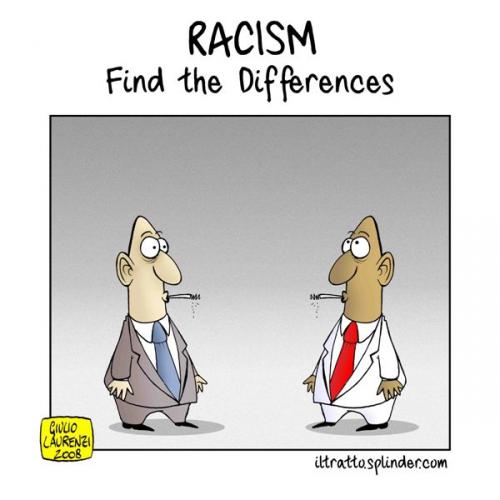
Original by Giulio Laurenzi
The issue then, is what constitutes “good” and “evil”? It goes back to the idea of categorization, and how it affects our judgements. I believe we all try to draw a distinction between circumstances vs decisions. One is within our control (and thus can be classified good / evil), whereas the other is something that we cannot do anything about. Categorization actually covers both aspects and it is through this that we form judgements. Good workers are those who are hardworking, take initiative, articulate, responsible… all characteristics describing a person. When we try to add “is Caucasian” into the mix, our alarm bells ring. On the surface, to describe a person as “Caucasian” is not really different from describing him/her as “articulate” in terms of criterion; They are both just characteristics used to form that judgement. What makes them different is that one is a matter of attitude and choice, whereas the other a matter of circumstances. It appears good and evil applies only when there is an element of choice, and if the characteristic is devoid of any choice (like your ethnicity), then it cannot be good or evil.
That sounds simple, but if we delve deeper, it gets more complex. Consider if the criteria for making a judgement is punctuality. If a person is punctual all the time, we say it is a positive trait because things can function more efficiently (activities move according to plan). Also, it’s a choice a person makes to BE punctual. Now let’s say, hypothetically, we could change our ethnicity on a whim. This means that what ethnic group you are from is a choice. Would it then be fair to call someone racist if he/she prefers to work with someone who is say Chinese? Couldn’t you CHOOSE to BE a Chinese in order to be a “better worker”? After all, if that person finds it is more efficient and easier to work, on what basis do I say it is wrong? On the flip side, if all the tardy people in the world band together and demand that they shouldn’t be judged because they are “inherently” tardy, would you accept such behaviour?
It gets even more confusing when we hear news that even our attitudes may not be entirely within our control. For example, extremely short tempered and aggressive people have tended to be viewed as due to their inability or unwillingness to control their emotions, but studies have shown they may be victims of circumstances rather than just because they can’t. It seems that it is marginally harder for them to do so due to their genetic makeup. Before we had this study, no one batted an eyelid if we were to decide to fire someone for being unable to control his/her temper. Now that we know it could have been due to him/her being born that way, has it changed our perspective just a little?
From this viewpoint, I venture to consider how mankind years earlier may have viewed the world and hence formed conclusions about others in pretty much the same way. It was generally ACCEPTED by society back then that those of a “lower” race could be accorded less rights simply by virtue of their ethnicity. This is not condoning their actions, but merely a statement of my opinion on how things came to be. In fact, even now, people have a tendency to prefer the familiar, and can relate better to those of the same ethnic group. While it should not be a standard to judge competency, one cannot deny that it is easier in some situations for someone “select” ethnic groups, but not others, to excel certain jobs. Going back to the example I gave, if you felt that even if the temper problem was not in his control, yet your organization is right to let him/her go, would you do the same for someone who, due to his ethnicity, fails to “perform”, or would you be more lenient? Food for thought.
Image by Michael Schamis
I personally believe it is impossible to remove entirely prejudices that people may have about certain ethnic groups. As the song from Avenue Q goes, “Everyone’s a little bit racist.” Acknowledging this fact will allow us to move forward to accept that perhaps the best way forward, isn’t to force everyone to “ignore color”, but to learn how to make important judgements based on a suitable criteria, one in which race is a minimal or totally irrelevant factor. I leave the last few lines of the song to end this piece:
Everyone’s a little bit racist
It’s true.
But everyone is just about
As racist as you!
If we all could just admit
That we are racist a little bit,
And everyone stopped being
So PC (Politically Correct)
Maybe we could live in –
Harmony!
I started writing my first blog many years back, but it died very quickly within a year. Since then, I have gone through the cycle of reviving my blogging activities and then letting it die a few times over because I never managed to continually maintain them for long. Each time I began, there was a sudden burst of energy and I had this picture in my head where I would churn out article after article that many would like to read. However, over time, the initial exuberance tapers off resulting in an old, out-dated archive which no one ever visits save for myself when I’m feeling nostalgic and need a trip down memory lane.
While I was embarking on this rebirth of my writing passion, I began to wonder what it was that inherently drew me to keep writing so much? Hadn’t the past “failures” taught me that I do not really have the required journalistic aptitude or stamina? Why do I keep coming back to this only to fail time and again? This bugged me because I knew that if I didn’t have the answer, or at least attempt to seek it, this project would not be sustainable.
So, struggling with my dilemma, I decided that in my maiden article I would try and justify why I’m reanimating my seemingly dead journalism attempts. Perhaps it’s some delusion of grandeur. Perhaps it’s just my stubbornness in not wanting to admit “defeat” or failure. Or perhaps it was some other inner desire to simply say what I want to say regardless of whether anyone is interested to listen.
While I was contemplating this, and attempting to do some research, I realized that the times I had such a strong desire to write was usually when there was SOMETHING to write about, and that something was always a new thought or idea that impressed me personally. The “enlightenment” brought about by the new idea became a driving force for me to become an outlet that shared this to others. It didn’t matter that the idea did not originate from me. I bought into the idea. I felt it was something WORTH TELLING.
It’s like when you discover this brand new restaurant that had great service, exquisite taste, and good value for money. You would definitely want to share it with your friends, your relatives, your colleagues and your peers! Have you ever wondered why, though? What drives you to want to take the effort to share something as trivial as a place to eat with others? I believe we all have this urge to share with others about things that we feel strongly about. Some may deem this obnoxious at times, but we can’t deny that such tendencies do exist, and it is so prevalent that there is even a marketing concept built on this phenomenon; The Word of Mouth.
My theory, is that this tendency is based on a rooted desire to be the one who can influence others. We do it with the intention of, hopefully, having the satisfaction to be the one who introduced something new and beneficial to the betterment of our fellow man. We have the desire to make an impact, a difference in the world, even if it is just as small as seeing your friends or relatives know of and enjoy a good place to eat, and it is all thanks to YOU.
Yes, there is definitely an element of egotistical pride in being the one who first brings this to the attention of others. This is especially evident when you hear statements like “And who was the one who introduced you to it/him/her?”. This also explains why some engage in activities like matchmaking. Altruistic? Probably to some extent, but it’s also true that we get a kick out of being a change agent in someone else’s life. I tend to see it as a combination of both. We tell ourselves that we just want to help. However, the tinge of pride will always be there, and it may not be a bad thing if it somewhat encourages altruism. Regardless of what the case may be, it appears that this prideful altruism is a factor in driving people to share.
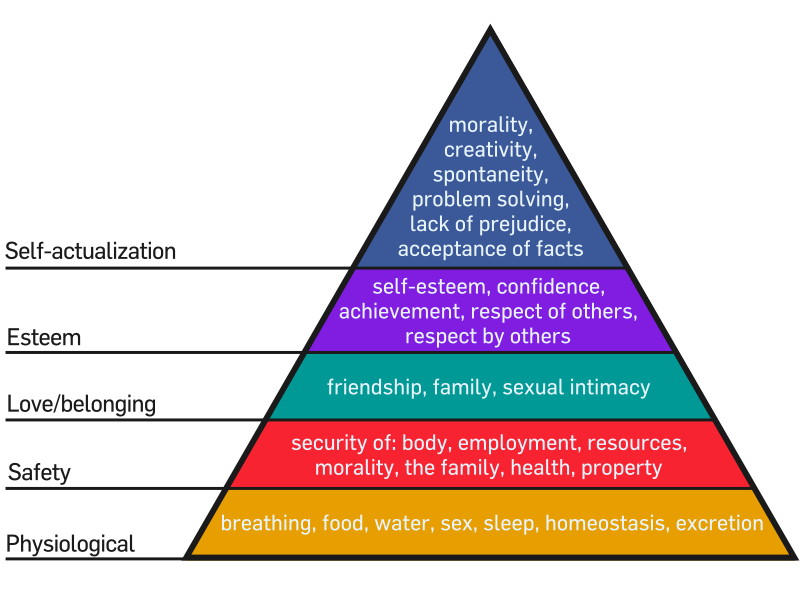
I recently had a conversation about how some people ought to be grateful for what they have instead of complaining about what they don’t. While I do agree with this sentiment, I cannot feel that we should be contented to the point where we stop being dissatisfied with where we are. That leads only to stagnation in my opinion. Interestingly, Maslow’s Hierarchy of needs comes to mind. We know there are people who do not even have their basic needs met (bottom of the pyramid, the physiological needs) and we should therefore be grateful that we (may) have at least attained the second level, the safety needs? Do we then stop fighting for the next level of needs to be met? I do not see it as ungratefulness if we push for it, even while we are thankful we are not at the bottom. They are not mutually exclusive.
Maslow's Hierarchy of Needs. Image taken from Wikipedia.
One of the key points of Maslow’s Hierarchy is that the highest need that a man can have, is for self-actualization. This is the need to realize one’s full potential, to become everything that a person is capable of becoming. Evidently, this relates to the concept of us trying our utmost best to influence the world around us, to express ourselves the best way we can, to make an impact in the lives of those around us.
It is important to note that this psychological theory has been criticized as it was formed based on individualistic qualities and disregards other societies which focus more on collective qualities. The basis for the hierarchy is thus brought into question; Do we all really aim for and value self actualization as the highest need? I then thought about this from the perspective of an Asian. Admittedly, we as Asians are more of a collectivist society and we worry constantly about “face”, or what others think about us. This is a domineering trait in most Asian cultures, although there are exceptions particularly those who are exposed to more “Western” influences. Again, no judgement calls here, but it does appear that those who adopt more “Western” beliefs tend to also be more individualistic.
If it were true, then according to Maslow’s Theory, we as Asians would more or less stop at esteem, where achievement and respect from others would be highest valued. This could explain why Asians tend to focus on bread and butter issues and there is a constant pressure to conform to the norm rather than to pushing self expression. The Asians who DO engage in self expression, more often than not tend to have been influenced by exposure to other cultures and values (the power of Western Culture through Hollywood and MTV). Conversely, the ones with a more Asian mindset tend to keep their self expressions in check.
So how does this relate back to my desire to write? I readily admit that I have been heavily influenced by Western culture, much more so than Asian ones. Yes I do retain many Asian traits, but since I grew up with English as my first language, and have been consuming American cartoons, movies and music for as long as I can remember, I would concede that I tend to identify with Maslow’s Hierarchy.
I have always been a big fan of TED talks. I have also tried to introduce others to TED (again, I’m trying to share this IMHO amazing concept with them). Have you ever wondered why TED Talks are so engaging and so interesting? Why do so many count it a privilege to be given the opportunity to speak at TED? It is a platform where we can share the newest ideas and information to others in the hopes that they will better themselves with it. The tagline for TED, is the phrase “Ideas worth spreading”. It appears the sharing of an idea, especially an idea that many believe is good, is something that invokes excitement and something that drives people to organize something like that.
We all have a desire to be the best, greatest person we can be, even if you are more “Asian”. We also desire to spread our influence, to see the effect we have on the lives of others. We take pride in sharing with others because when we come to know something that we believe is beneficial and good for us, we share it in hopes that we can also help make a difference by bringing that same benefit to them. This is the reason why when I feel enlightened, either by a new thought or a new idea, or if I have a strong opinion which may present a fresh perspective to an issue, I fire up my thinking juices and try to convert all the threads of thought in my mind into a decent piece of reading that will, hopefully, make a difference to someone… It remains to be seen if I will be disappointed.






 Travel insurance is another thing that’s important. I had the unfortunate experience of having my luggage misplaced on connecting flights, and this has happened more than once! I’ve learned to make it a point to get travel insurance whenever taking more than one flight as there is actually quite high a risk that you will land without your luggage. On my last trip to Montreal, when I had two transfers to make, my luggage was actually stuck in Hong Kong, and it took more than 72 hours to get it delivered to me. Thankfully, the airline was kind enough to authorize me a reimbursement of USD300 for my troubles, but it was a very VERY tedious process. I could have easily made that claim and avoided all that hassle had I got travel insurance (something my HR / Admin staff neglected to purchase together with my flight). Of course it may not happen to you, but it is a crappy feeling to arrive at your destination, half way around the globe, only to find you do not have your luggage with you. I was there for two weeks, and thank GOD it wasn’t winter!